Pastoral Letter of the Bishop on Re-awakening Eucharistic Faith

My dear brothers and sisters,

Today marks the beginning of a new year in the life of the Church. Advent places all the turmoil of history and the upheavals of the present pandemic in one and the same perspective: that of Christ’s return “with power and great glory”.i Our contemporaries might see time as an inevitable path of progress, whereby humanity throws off the moral constraints of Christianity. How often do we hear it suggested that it is inevitable that society will progress to removing all barriers to killing the unborn, or assisting the suicide of the sick, or rejecting the model of the family founded on marriage. Tragically, some see this as human progress. The Gospel offers a radically different itinerary, seeing this time as the moment of witness ushering in the dramatic struggle of the last days, marked by the trial of evil which does not even spare the Church.ii

Yet, as the Catechism reminds us, all time is moving towards the hour which we pray is hastened, when we say: “Marana-tha! Our Lord, come!”.iii Indeed, “whenever the Church celebrates the Eucharist, she … turns her gaze ‘to him who is to come,’ knowing that, “the Lord comes even now in his Eucharist and that he is here in our midst”.iv Advent reminds us that our time must be marked by alertness as we heed Our Lord’s call to: “Stay awake, praying at all times to survive all that is going to happen, and to stand with confidence before the Son of Man”.v

The pandemic years have led to such a re-awakening in our parishes as many have recognised anew, the Eucharistic Presence of the Lord Jesus, and the need to participate actively in the Sacrifice of the Mass and the grace and forgiveness which awaits us in Confession. I am especially conscious of those who remain medically vulnerable and are unable to return to Mass this Winter. Let us not forget these most isolated members of our communities and help them remain connected to the life of the Church. Yet, we must also be aware of those who may have ‘fallen asleep’ and be in danger of losing the perspective of what ultimately matters in time and for all eternity. Let us think of those who may not with us at Mass and seek actively to help and encourage each one to make their return this Christmas and in the new year ahead. This involves not merely a change of priorities on a Sunday but the same re-awakening to the presence of Our Lord. Let our help for them begin with prayer and our own example.

Pope Francis has asked that this be a time marked by listening. Attentive listening is not always easy in our lives or relationships, nor is it easy when we come to the silence of prayer. We all too readily hear only the sound of our own voices; and can struggle to find the silence which allows us to be attentive to the presence of the Lord. Soon we will celebrate, that on the first Christmas night, while the whole world slept, poor shepherds alone heard the voice of Heaven. In one of the best loved Christmas Carols we sing of the silence of that Holy Night declaring: “How silently, how silently the wondrous gift is given …” In silence the Saviour was born for us. It is in an atmosphere of silence in every Mass, that we hear God’s Word and receive the wondrous gift of the Eucharist. As the Saint of Calcutta, Mother Teresa reminded us, it is in silence before the Holy Eucharist that we also learn to be attentive to the spiritual and material needs around us. Let us rediscover this precious silence in all our churches so we can once more hear “the news of great joy”;vi and recognise “Emmanuel God-with-us”vii in the Blessed Sacrament of the Eucharist. This would surely be the greatest outcome of this time of listening, which Pope Francis describes as leading us all to the supreme prayer of adoration – which is reverent silence in the presence of God.viii

May this new year in the Church’s life be marked by such a re-awakening, so we recognise the purpose of our time. Let us be attentive to the reality of the Eucharist which contains the Church’s entire spiritual wealth, Christ Himself;ix and aware of our constant need of grace and conversion in the Sacrament of Penance and Reconciliation. May we also be ready to help others to awaken in Eucharistic faith and in the words of the Gospel hold “their heads high because our redemption is near at hand”.x

Let us ask Our Lady, Help of Christians to guide us all as we prepare to share the joy of Christmas,

+ Mark
Bishop of Shrewsbury

i Mk. 13:26
ii Cf. Catechism of the Catholic Church no. 1403
iii Catechism of the Catholic Church no. 671
iv Catechism of the Catholic Church no. 404
v Lk. 21: 36
vi Lk. 2: 10
vii Mt. 1: 23
viii Cf. Homily of the Holy Father for Opening the Synodal Pathway, 10th October
2021 & Catechism of the Catholic Church no. 2628
ix Cf. Presbyterorum Ordinis no. 5
x Lk. 21: 28
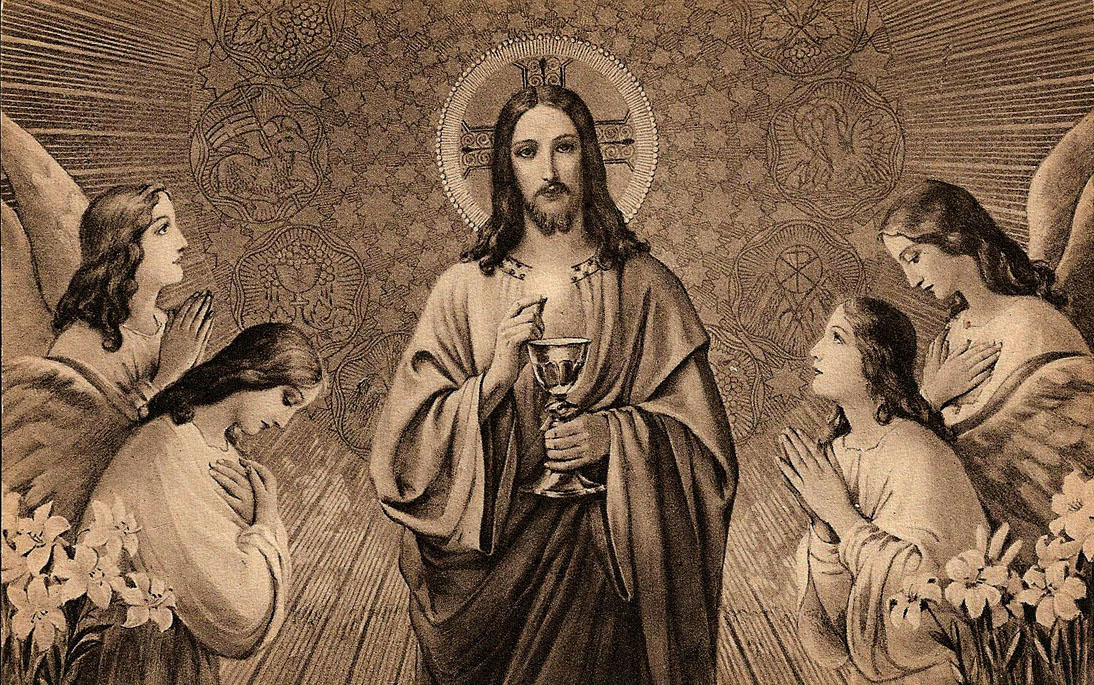
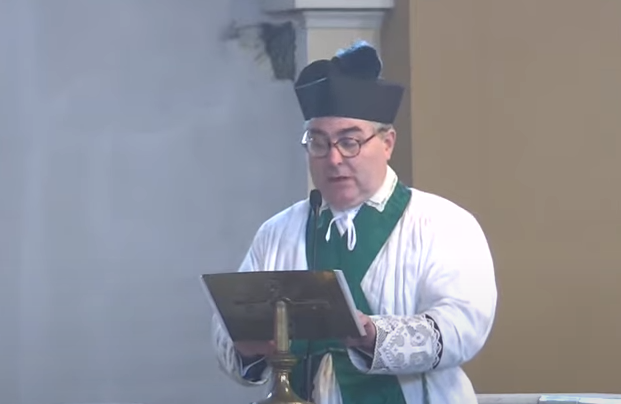


First Holy Communion

Sunday, October 31st 2021 – Feast of Christ the King

On the feast of Christ the King, titular feast of our Institute, a group of children in our community will receive the Eucharistic Lord for the first time. We all join the families of these young faithful in their joy and gratefulness. Please pray for our children, especially in preparation of this important day in their lives.

If you wish your child to participate in this year’s First Holy Communion, please contact Canon Wiener via details here.

First Communicants will meet with Canon Wiener in the presence of their mothers and/or fathers to answer fundamental but simple questions regarding the Church’s teaching about the Eucharist. Please make an appointment with Canon for the week of October 25th-30th.

First Confessions are possible daily (30 minutes before each Mass) or upon appointment.

Canon Gribbin’s Farewell to Shrewsbury!

Canon Gribbin, as announced here, will leave St Winefride’s for Ardee, Co. Louth to be chaplain to the Sisters Adorers of the Royal Heart of Jesus. He will celebrate a farewell Mass here on the 26th September at 12.30pm

General Chapter

Canon Wiener will be leaving Shrewsbury between August 8th and August 28th to visit Germany and to attend the chapter in Gricigliano. Please pray for the superiors of the Institute and all canons attending this year’s chapter as also for Canon Wiener’s safe return to Shrewsbury.

During Canon’s absence Father Anselm Gribbin will return to Shrewsbury to celebrate all weekday Masses between Wednesday, August 11th, and Sunday, August 22nd (incl.). The Masses on August 9th and 10th had to be cancelled.

During the chapter meeting, Father Gerard McGuiness most generously agreed on coming to St. Winefriede’s to celebrate the daily Masses between Monday, August 23rd and Saturday, August 28th (incl.). The usual Mass schedule applies. However, the Adoration and Benediction on Tuesday, August 24th and August 26th has had to be cancelled.

On Sunday, August 29th, Father Stephen Goodman of the Archdiocese of Birmingham (Wolverhampton) will come to us to celebrate the Mass at 12:30pm. We are most grateful for Father’s generous offer to assist Canon Wiener who, due to COVID travel restrictions, will not be able to celebrate publicly for several days after his return. Father Gribbin will celebrate the weekday Masses of August 30th to September 4th.

Brown Scapular Enrolment

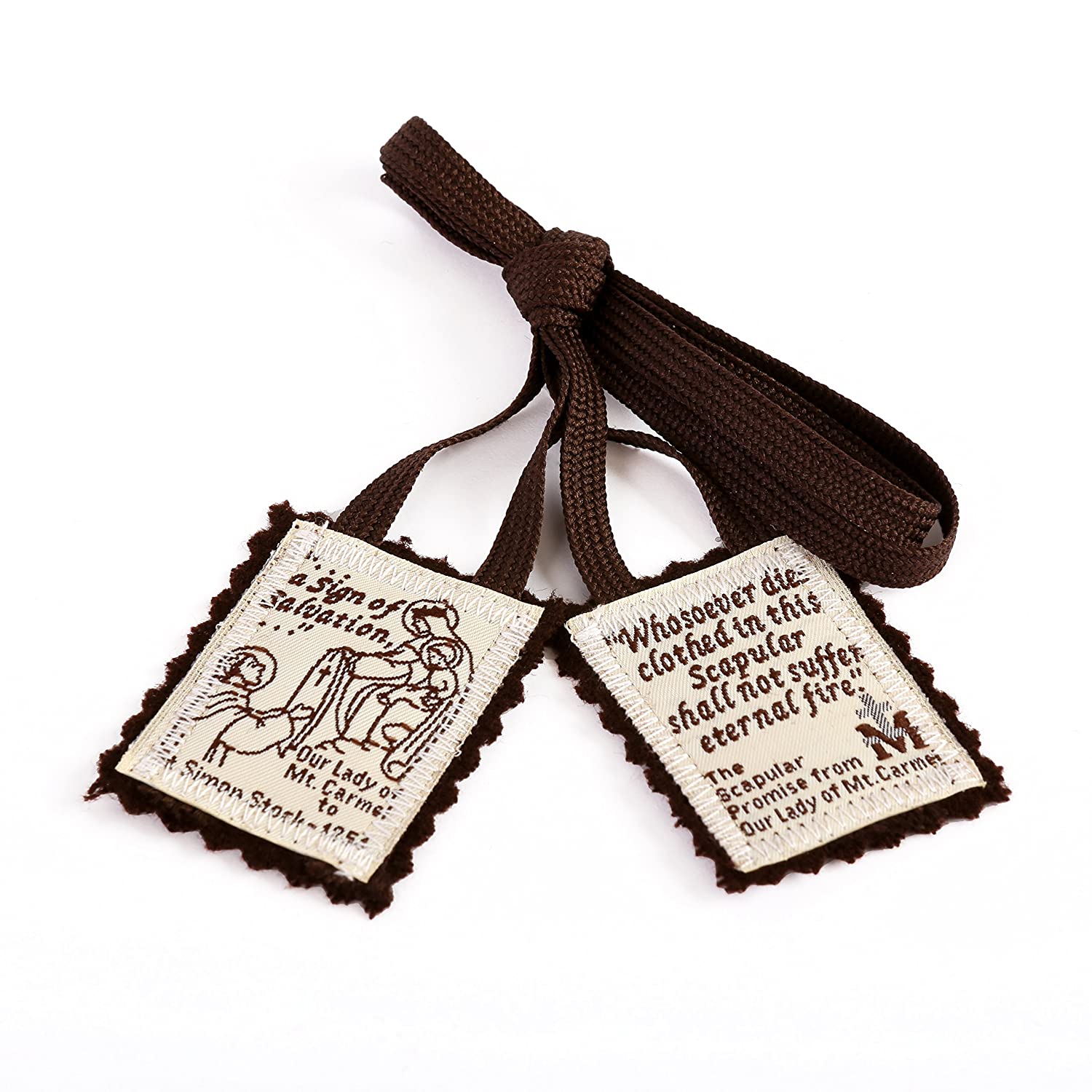
In the year 1251 Our Lady appeared to St. Simon Stock, an Englishman and Prior of Carmelite Order. She handed him a brown woolen scapular and said, “This shall be a privilege for you and all Carmelites, that anyone dying in this habit shall not suffer eternal fire.” In time, the Church extended this magnificent privilege to all the laity who are willing to be invested in the Brown Scapular of the Carmelites and who perpetually wear it.

The Blessed Virgin of Mount Carmel has promised to save those who wear the scapular from the fires of hell and to shorten their stay in purgatory if they should pass from this world still owing some debt of punishment.This promise is found in a Bull of Pope John XXII. The Blessed Virgin appeared to him and, speaking of those who wear the Brown Scapular, said, “I, the Mother of Grace, shall descend on the Saturday after their death and whomsoever I shall find in purgatory I shall free so that I may lead them to the holy mountain of life everlasting.”

Unlike typical sacramentals, scapulars are not merely blessed, but need to be invested/imposed by a priest to enroll the faithful.Any Catholic priest may invest a baptized Catholic with the Brown Scapular. Lay people are unable to bless a Scapular

On Sunday, July 18th 2021 after the 12:30pm Sung Mass at St Winefride’s there will be an enrolment for those wishing to avail of this powerful sacramental. Scapulars will be available on the date.

Elements of Catholic Reform Bases on Truth

Canon Wiener has ordered copies of Msgr. Rudolf Michael Schmitz’ “Elements of a Catholic Reform Based on Truth.” Monsignor talked in 2018 at the ‘Catholic Voice’ conference in Limerick and gave in this fascinating presentation a comprehensive description of the most important areas in the Church’s life. His Eminence, Raymond Leo Cardinal Burke wrote the foreword. – These booklets will be available for purchase after Mass on Sunday 20th June (£3.00).

Scaffolding Works at Shrewsbury Cathedral

During the week of Monday, June 14th to Friday, June 18th scaffolding will be erected in the Cathedral. Masses in the Extraordinary Form (Adoration/Benediction included) will be transferred to St. Winefride’s church according to the usual schedule:

Monday: 10:00am Holy Mass
Tuesday: 6:30pm Holy Mass; (5:30-6:15p Adoration/Benediction)
Wednesday: 10:00am Holy Mass
Thursday: 6:30pm Holy Mass; (5:30-6:15pm Adoration/Benediction)
Friday: 10:00am Holy Mass

Pastoral Letter: Rebuilding on the Foundation of the Eucharist , First Sunday of Lent, 21st February 2021

My dear brothers and sisters,

On this First Sunday of Lent, the story resonates for us, of a family enduring a great trial that engulfed the world they had known. The Book of Genesis recounts how Noah and his family emerged from ‘a state of lockdown’ with renewed hope in God’s saving purpose. The rainbow set against the clouds became a sign of hope for them, as it has become a sign of hope in this health crisis, whether painted by children, posted in windows or projected on public buildings. The rainbow has happily recovered its original meaning as a sign of the promise of the Lord: “When … the bow appears in the clouds, I will recall the Covenant between myself and you and every living creature”.[i] Despite all human sinfulness, and the disasters resulting from sin, God’s purpose is always to save and bring us to new life. This is our personal experience every time we make a sincere confession and know the grace of the Holy Spirit sent for the forgiveness of sins.[ii]

Almost twelve months have passed since I wrote at the start of a pandemic that has impacted every one of our lives. As this Lent begins, we remember in prayer all who have died, and more than a hundred thousand families who today mourn the loss of loved ones. We can draw lasting lessons from the suffering of this time and its quiet heroism. Many of these lessons echo the call of Lent to greater prayer, self-denial and generosity. Today, I wish to highlight lessons learnt from the way our parishes rose to challenges, reminiscent of the brave beginnings of this Shrewsbury Diocese. As in those pioneering days, the continued celebration of the Mass – the priority of the Eucharist – has become the focus of so many strenuous and unprecedented efforts. It has also been the aspiration of many who have remained prayerfully at home, often using the internet to stay connected, while anticipating the day of the great return to Holy Mass.

As we face the challenges of emerging from the devastation of a pandemic, let us be ready to re-build the life of the Church on this same foundation of the Eucharist. The Book of Genesis tells how the priority for Noah’s family, having barely set foot on dry ground, was to build an altar for the Lord.[iii] In the same way, our union with Christ in the Mass, in the Sacraments and in daily prayer, must be our own enduring priority. At the Cathedral, the works to renew the Altar have coincided with this time and will stand as a memorial to these days of renewed Eucharistic faith and love. The very restrictions imposed by the pandemic have helped us treasure our churches as places of prayer, silence and personal encounter with Christ. In so many ways we have been led to recognise anew, as the Catechism reminds us that “In his Eucharistic presence He remains mysteriously in our midst as the One who loved us and gave Himself for us”.[iv] It is Jesus Himself who awaits us in the Sacrament of His love.[v]

I hope we will continue to make generous efforts in 2021, to keep church doors open wherever this is possible; and ensuring we give of our best in everything connected with the Mass and the adoration of the Blessed Sacrament at the heart of every one our communities. If Eucharistic love pervades our parishes, then we can be sure nothing will be lacking in our sense of mission.

At the start of my letter, I said we are setting out to re-build on the foundation of the Eucharist. Saint John Paul II put this simply when he said, the Eucharist builds the Church.[vi] He recalled the teaching the Second Vatican Council which declared, “As often as the Sacrifice of the Cross … is celebrated on the altar, the work of redemption is carried out … and at the same time … the unity of the faithful, who form one body in Christ, is expressed and brought about”.[vii] May this be so for us in 2021, as we gather in ever growing numbers to fulfil Christ’s command “Do this in memory of me”.[viii]

May Saint Joseph, to whom we have entrusted this year of recovery, pray for us and accompany us as we grow in Eucharistic love,

+ Mark
Bishop of Shrewsbury

[i] Gen. 9: 14
[ii] Cf. Rite of Penance
[iii] Cf. Gen. 8: 20
[iv] Catechism of the Catholic Church n. 1380
[v] Cf. Dominicae Cenae n.3
[vi] Cf. Ecclesia De Eucharistia Chapter 2

A Pastoral Letter on Public Worship and Public Responsibility

My dear brothers and sisters,

As I write, a third National Lockdown has begun with many restrictions reducing our daily lives to “essentials.” The Government now recognises public worship as one of those essentials. Not a few may ask why churches remain open when other activities are prohibited; and some will question why worship remains the only legally permitted public gathering. Yet, we know that worship is not only a fundamental freedom: it is our primary human vocation. In short, worship is what we were made for! [1] The Catholic faith teaches that this worship is supremely offered in the Sacrifice of the Mass in which God is glorified and humanity sanctified.[2]

It is your witness to this truth, which I have no doubt, has enabled public worship to be recognised as essential to society during this renewed lockdown. It is almost certainly the care with which all safety measures have been implemented in parishes which has now allowed the celebration of Mass and the Sacraments to continue. I wish, once again, to record my thanks to the clergy, the teams of parish volunteers and every member of the faithful who have together implemented and followed these safety requirements.

In all of this, we recognise the seriousness of our responsibility to help ensure the continuance of public worship and the safety of all. I ask you at the beginning of this New Year and a renewed state of lockdown, not to assume we have yet returned to “normal life” in our parishes; nor to give way to any sense of complacency, especially whilst a new variant of the virus is spreading rapidly. The continuance of public worship into Lent and Easter will, in large measure, depend on our vigilance and all our efforts to follow the measures which have already made our churches among the safest places in society.

In my letter to you in March of last year, I wrote of how these safety requirements can be lived in a spirit of charity. We continue to see how these demands call us to a refinement of charity. Requirements as strange – yet now so familiar – as social distancing, hand sanitising in church and wearing face coverings can serve as expressions of our love for our Lord and our love for the Mass, which continues to be publicly celebrated because of the careful fulfilment of such duties. If we ever feel fatigued in carrying out these requirements, let us renew them with love. At the end of the Christmas celebration, let us also do so with our gaze fixed on the Holy Eucharist, where the same Lord Jesus is now truly present whom wise men once fell down and worshipped; and whom Saint John the Baptist declared himself to be unfit even to kneel at His feet [3].

As I picture you gathered in all the churches of the Diocese, may Saint Joseph – the man who goes unnoticed, a support and guide in time of trouble [4]. – accompany us through these troubled times in fulfilling the greatness of our call to worship and our responsibility both to each other and to the whole of society.

Entrusting each of you to Saint Joseph’s prayers,

+ Mark, Bishop of Shrewsbury

  1. Cf. Catechism of the Catholic Church n. 2096
  2. Second Vatican Council Sacrosanctum Concilium n. 7
  3. Cf. Mt. 2: 11, Mk. 1: 8 & Decree on the Most Holy Eucharist, Council of Trent Session 13 4 Cf. Patris Corde 8th December 2020

Christmas can never be cancelled even in the most unfavourable of conditions: Bishop Davies

Christmas can never be cancelled even in the most unfavourable of conditions, the Bishop of Shrewsbury said in his Christmas homily.

During midnight Mass at Shrewsbury Cathedral, the Rt Rev. Mark Davies acknowledged that it is “easy to focus on the dark shadows” of 2020.

But he reminded the congregation that Christmas leads the faithful back to the “point of light” that shines in all our darkness, the child born for us all.

“Christmas can never be cancelled,” Bishop Davies said, “for its light is not dependent on favourable conditions for even the darkness makes its light shine the more brightly”.

Besides the coronavirus pandemic, the Bishop also lamented attempts over the passing year to extend abortion and the renewed efforts to legalise assisted suicide as assaults upon the sanctity of human life.

He reminded the faithful that the modern nursing and medical profession was inspired by Christian belief in the value and inviolability of innocent human life and for the care of the weakest and most vulnerable in society.

The dedicated service and self-sacrifice shown by medical professionals in helping the victims of Covid-19 stood in a stark contrast to the “culture of death and despair,” the Bishop said.

He encouraged people either attending the Christmas Mass in person or viewing by live-stream to heed the words of Pope Francis in his Apostolic Letter, Patris Corde, of December 8, and to share with St Joseph the responsibility for “every poor, needy, suffering or dying person, every stranger, every prisoner, every infirm person” in whom the Child Jesus can be recognised.

Also echoing the hopes of Pope Francis, the Bishop said that “a new vision of fraternity and social friendship” which recognises how all the lives of all people are bound together is the antidote to “present-day attempts to eliminate or ignore others”.

“This is surely a happy lesson to be drawn from the trauma of the past year,” the Bishop said.

Bishop Davies said: “At the cradle of Bethlehem, we have learnt to value the life and dignity of every human being, especially the weakest and most vulnerable. The recognition of the sanctity of human life and the cherishing of the frailest – both notions utterly unthinkable to the ancient mind – would become the light which forged our civilisation; the vision, which first inspired our medical and nursing professions and has guided our best efforts in response to the recent pandemic.

“For we heard the voice of the same Child of Bethlehem say, ‘Whatever you do to the least of my brothers and sisters you do to me’. And we now see the stark contrast between a culture of death and despair, which readily discards human life, and that spirit of charity and self-giving service Christ’s coming inspired: a contrast between darkness and light.”

He said: “How precarious Christian civilisation can appear in the face of an ever-growing assault upon the value of human life whether in the extension of the legalised killing of the unborn; or in the increasing threat to the elderly and vulnerable by euthanasia under the guise of ‘assisted suicide’.”

The bishop added: “Amid every lengthening shadow, may we never lose the light of the Child who was born for us, who allows us to glimpse who we really are and discover our deepest identity as children of God. At this Christmas of 2020 and in the face of the challenges of a New Year to come, may we return to the light which first dawned in Bethlehem, the same light which shines for us at every ‘Christ’s Mass’.”