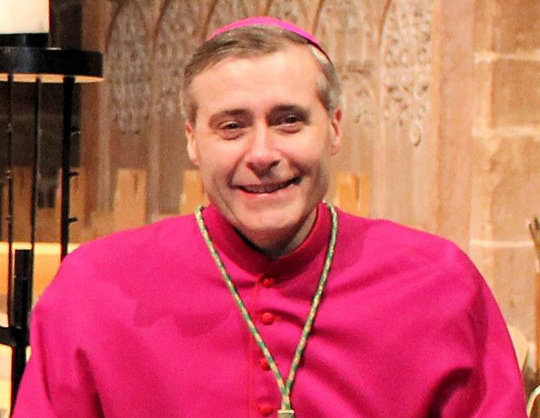
My dear brothers and sisters,
On this First Sunday of Lent, the story resonates for us, of a family enduring a great trial that engulfed the world they had known. The Book of Genesis recounts how Noah and his family emerged from ‘a state of lockdown’ with renewed hope in God’s saving purpose. The rainbow set against the clouds became a sign of hope for them, as it has become a sign of hope in this health crisis, whether painted by children, posted in windows or projected on public buildings. The rainbow has happily recovered its original meaning as a sign of the promise of the Lord: “When … the bow appears in the clouds, I will recall the Covenant between myself and you and every living creature”.[i] Despite all human sinfulness, and the disasters resulting from sin, God’s purpose is always to save and bring us to new life. This is our personal experience every time we make a sincere confession and know the grace of the Holy Spirit sent for the forgiveness of sins.[ii]
Almost twelve months have passed since I wrote at the start of a pandemic that has impacted every one of our lives. As this Lent begins, we remember in prayer all who have died, and more than a hundred thousand families who today mourn the loss of loved ones. We can draw lasting lessons from the suffering of this time and its quiet heroism. Many of these lessons echo the call of Lent to greater prayer, self-denial and generosity. Today, I wish to highlight lessons learnt from the way our parishes rose to challenges, reminiscent of the brave beginnings of this Shrewsbury Diocese. As in those pioneering days, the continued celebration of the Mass – the priority of the Eucharist – has become the focus of so many strenuous and unprecedented efforts. It has also been the aspiration of many who have remained prayerfully at home, often using the internet to stay connected, while anticipating the day of the great return to Holy Mass.
As we face the challenges of emerging from the devastation of a pandemic, let us be ready to re-build the life of the Church on this same foundation of the Eucharist. The Book of Genesis tells how the priority for Noah’s family, having barely set foot on dry ground, was to build an altar for the Lord.[iii] In the same way, our union with Christ in the Mass, in the Sacraments and in daily prayer, must be our own enduring priority. At the Cathedral, the works to renew the Altar have coincided with this time and will stand as a memorial to these days of renewed Eucharistic faith and love. The very restrictions imposed by the pandemic have helped us treasure our churches as places of prayer, silence and personal encounter with Christ. In so many ways we have been led to recognise anew, as the Catechism reminds us that “In his Eucharistic presence He remains mysteriously in our midst as the One who loved us and gave Himself for us”.[iv] It is Jesus Himself who awaits us in the Sacrament of His love.[v]
I hope we will continue to make generous efforts in 2021, to keep church doors open wherever this is possible; and ensuring we give of our best in everything connected with the Mass and the adoration of the Blessed Sacrament at the heart of every one our communities. If Eucharistic love pervades our parishes, then we can be sure nothing will be lacking in our sense of mission.
At the start of my letter, I said we are setting out to re-build on the foundation of the Eucharist. Saint John Paul II put this simply when he said, the Eucharist builds the Church.[vi] He recalled the teaching the Second Vatican Council which declared, “As often as the Sacrifice of the Cross … is celebrated on the altar, the work of redemption is carried out … and at the same time … the unity of the faithful, who form one body in Christ, is expressed and brought about”.[vii] May this be so for us in 2021, as we gather in ever growing numbers to fulfil Christ’s command “Do this in memory of me”.[viii]
May Saint Joseph, to whom we have entrusted this year of recovery, pray for us and accompany us as we grow in Eucharistic love,
+ Mark
Bishop of Shrewsbury
[i] Gen. 9: 14
[ii] Cf. Rite of Penance
[iii] Cf. Gen. 8: 20
[iv] Catechism of the Catholic Church n. 1380
[v] Cf. Dominicae Cenae n.3
[vi] Cf. Ecclesia De Eucharistia Chapter 2